• Skip to primary navigation
  • Skip to main content
  • Skip to primary sidebar

Head4Leadership HomepageHead4Leadership

Leadership and Neuroscience Coach

Email: dominique@head4leadership.co.uk
Call: 07703 564451

  • Home
  • About
    • Working with Head 4 Leadership
    • Knowledge and experience
    • Testimonials – What people say
  • Coaching Services
    • Heads Together – Leadership development workshops
  • Event speaker
  • News & blog
  • Contact

#Neuroscience

30th August 2022

Leading, it was all going so well until…

How my coaching approach can help leaders when it gets tough.

It can all be going well and then…

Even (but not only) clients that are established leaders, at the top of their game, can get caught in a cloud of doubt.

For one client is was a series of small oversites. They managed them with no big impact on overall results, yet it knocked them trusting themselves.

For another it was a buy out that had an almost overnight impact on their being scrutinised for every action and decision.

A further client found that a change in the team upset their sense of place and a negative change in their behaviour and mindset ensued.

Another was worn out with coping following Covid restrictions and a constant sense of needing to adapt and change.

Get in touch

Managing intense feelings requires emotional awareness

Even with the clarity of objectives, goals, vision and process (and if you don’t have these, how can you have focus for what’s important workwise?), it’s how a situation makes you ‘feel’ that can take you off course from leading well and being well.

‘Leaders with empathy (EQ*) perform over 40% higher in employee engagement, decision-making, and coaching’.

Harvard Business Review via – https://www.soocial.com/emotional-intelligence-statistics/

Five ways coaching with me can build your leadership EQ* and mental strength?

When you know, you cannot unknow. My coaching approach builds on what you know, widening your options for managing your self and others:

  1. Psychometrics and 360 feedback to enhance self awareness
  2. Exploration for learning to manage feelings, so you can respond v re-act
  3. Reflection time to digest actions, options and desired outcomes
  4. Proven neuroscience insights that will aid resilience, optimism and confidence
  5. Leadership techniques to enhance team and individual performance

*Emotional Intelligence

You are not alone and I could be the coach that can help you to reconnect with all the benefits that leading can bring.

Get in touch

Filed Under: Coaching, DS Consulting, Leadership & Development, Neuroscience Tagged With: #Coaching, #Leadership, #Neuroscience, Resilience

8th July 2022

Does your work fulfil your purpose?

Three steps to finding your purpose and fulfilling it.

Head 4 Leadership

Do you ever have moments where the work you do, who you do it with and how you do it starts to niggle? 

Something doesn’t feel right anymore, and you may or may not know what is causing that.

Covid lockdown and remote working created space for considering how we live our lives and how we earn money to live that life.  Many renegotiated their hours, where they work, and a high number of people resigned. 

Resigning is a big step, and for some, that decision may have been made in haste.

Will resigning be the best step toward your true purpose?

One way to check this is to establish or re-establish connection with your purpose.  Your ‘Purpose’ is defined by your reason for being, it is what gets you out of bed in the morning, it gives you a drive, direction and motivation.

Your purpose changes through life and your may not have realised a change in yours.

You have an inbuilt neurobiology to find connection and shared purpose with others. It is what helps humans survive and thrive.

When there is disconnection through shared purpose it creates unsettling feelings, raises stress levels and can impact your confidence and self-belief. Your work-place is an important arena for connection with others and knowing your purpose can help you assess why you do what you do and if you are in the right environment.

Find your purpose using IKIGAI

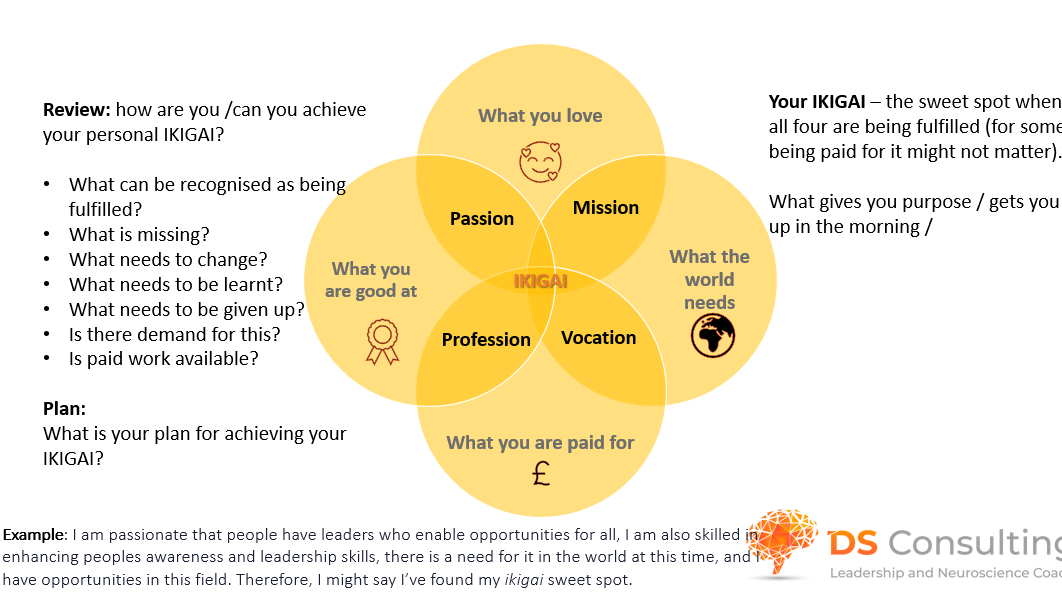
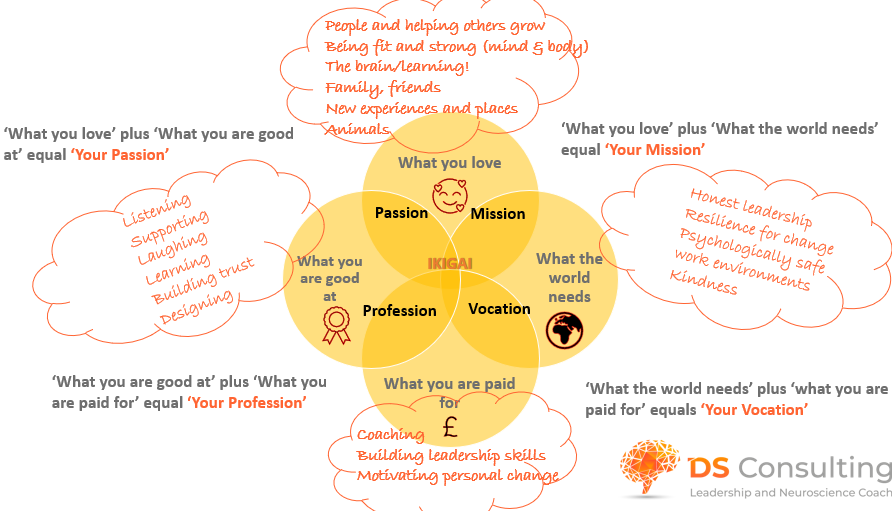
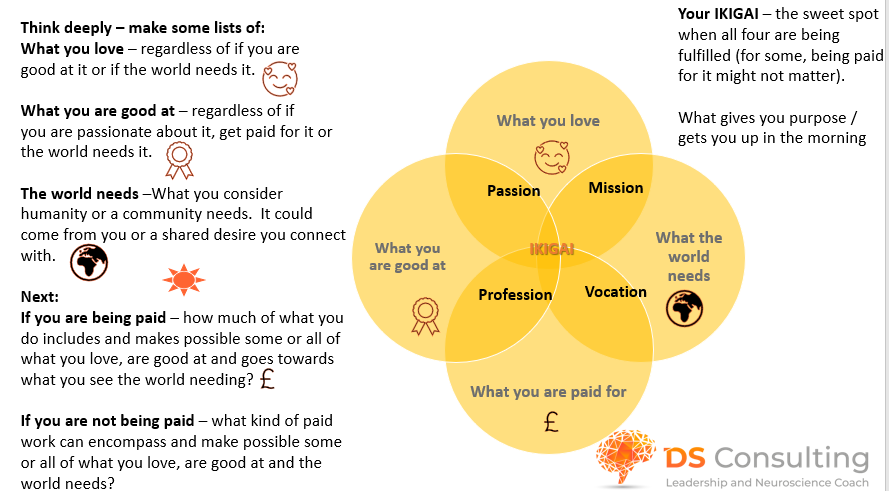
Ikigai is a Japanese word that combines the terms iki, meaning “alive” or “life,” and gai, meaning “benefit” or “worth.”  IKIGAI in terms of your career, is the sweet spot, where three key areas align with the work you do now or can steer some changes in your career.

Want help finding you IKIGAI?

Three steps to identifying your IKIGAI / purpose

Step one – Self-reflection – without boundaries

Head 4 Leadership

Step two – Reflection analysis – What purpose has been revealed, how close are you to living it, how does your current work situation fulfil it or not?

Step three – Plan the changes that can give you that fulfilment.

Reach New Heights

My IKIGAI

Head 4 Leadership

Your purpose, your IKIGAI, enables you to bring your authentic self to the workplace. 

Some may say values do that, and they are an aid.  The piece about what the world needs is what makes the difference. Being able to connect to it, express it, stand up for it and represent it.

Not everyone will agree with your purpose or like you for it, yet they will see the real you.

If you are unable to do what you love, unable to do what you are good at and see that what you do makes a positive contribution to the world, it could be time to start looking at your career choices?

Does the organisation you work in have a purpose you connect to?

If so, the opportunity of doing a little more of what you love and are good at is all you need. Some organisations give people time in the year to do something that matters to them or to learn something in which they are interested.  That might be all you need. 

What next?

  • Have a go at finding your IKIGAI
  • Share it with your leader/manager/team so they can understand you even more. compare with their purpose
  • See how any gaps can be filled in work or outside of it – sometimes it’s not paid work.  It could be raising money for something or volunteering.

Want help with this or to learn about how else I can support leaders to be their best for their teams and their team’s performance and engagement

Get in touch

Learn more about my Headstrong Coaching Programme – Reach New Heights in Leadership and Life

Headstrong Coaching Programme

Filed Under: DS Consulting Tagged With: #Coaching, #Leadership, #Neuroscience, #neuroscience #coaching #confidence, #purpose, Resilience

8th December 2021

How Can Leaders Cut Down Workplace Loneliness? Read on.

Loneliness is not seasonal but often highlighted at this ‘Merry’ time of year.

In many parts of the world Christmas time is a set of days when there is a bombardment of festivity.  A period where expectations are raised.  A month with pressure to be joyful.  A chapter when bereavement and loss are reawakened.  And, in 2021 a time with pandemic uncertainty continuing to impact how we spend our time.

Defining loneliness

It can be hard to explain, some researchers define loneliness as perceived social isolation, a feeling of being unconnected from or not connected at all to the social contacts we desire.  From a neuroscience perspective, we are wired to survive through human connection.  Survival has been achieved through social group connections – we are stronger together!

This matters as it has been shown in Studies that a prolonged sense of isolation (triggering stress hormones and chemicals) will impact health and wellbeing, maybe more seriously than drinking or smoking.

Some stats on loneliness

This chart (sourced from The Jo Cox foundation) shows stats from 2017, naturally not including the impact of Covid.  These stats plus Covid restrictions, make it even more likely that someone in your team or organisation have, are or will experience periods of loneliness; and Christmas time is known to exacerbate this.

According to the data below, if your workplace includes: 17–25-year-olds, anyone with a disability, a parent or carer there is a high probability that quite a few of them may feel lonely.  I think I can safely assume that other personal situations (e.g. age, gender, race, addiction) that have not been mentioned can also contribute to these feelings.

What’s the impact of loneliness for business?

Monetise the following and the cost to business becomes clear.  Isolation or a sense of it causes withdrawal from a group or organisation.  This tactic is a protection strategy from further rejection.  A sense of disconnection leads to reduced commitment, innovation and collaboration.  Through feelings of not being connected to or being cared about by others, the work suffers in both its quality and volume.  The energy and distress that comes with ongoing loneliness also leads to absence and errors.

A personal loneliness experience

I have certainly had painful moments of loneliness. One of my moments came from the break-up of a business and partnership.  For years I carried a lot of guilt and shame about the business loss and betrayal from the partnership aspect.  I ‘felt’ I had no one to turn to, I did not want to share the failure and potential judgement with friends or colleagues.  Family was impacted and seemed too close, so I ‘believed’.  For many years, despite battling on and getting through, I still ‘felt’ different, stupid for letting this happen and embarrassed.  My confidence in my judgement of situations and people was hit badly.  It took the work I do now (a career change of decades) to help me make proper use of that experience and what I could learn from it.

How leaders can identify loneliness and act to reduce it

Building psychological safety is a big part, that generates safe spaces for sharing.  How can this be achieved?  It takes time, you need to:

  1. Get to know your team as individuals, discuss (yes, talk!) about each other’s experience, successes, challenges, past failures.  Listen to and share family situations and the pressures or joys that may be present there.  Acknowledge birthdays or special events. Doing this regularly through one to ones helps make vulnerability acceptable and builds trust.
  2. Get the team to know the team, similar to above, build a habit of sharing thoughts and feelings in a respectful way.  Teams that know each other can help spot when somethings different and raise it appropriately, rather than it going unnoticed.

Questions to aid identifying loneliness and help find a way forward.

In a perfect world…

  1. How could the working environment be improved for you? This question can highlight how office layout, home working, working hours or geography for example, is impacting a person.
  2. What ways of working in this team would keep or increase your motivation? For example, the reward mechanisms of a team can make a difference (commission structures, can shift healthy competition to underhand behaviour), how you communicate, protocols and processes, vision and goal clarity.
  3. What would change to really help you thrive in this role/team? This question opens the door to how people behave, the culture, the norms, what this person values.
  4. What can I do to be even more helpful to you? A question that recognises a leader’s role in shaping a team and treating each person as an individual that is cared about. 

Are you lonely? Have you tried these?

If you are lonely, this link gives nine ideas to experiment with,  especially as, if you do nothing differently, nothing or little is going to change.

What about Christmas time?

And lets include other festive occasions, if working from home remains or someone is away a lot?

I asked some valued connections and based on having done the ground work of building trust a few ideas came through:

  • Enquire into when people get lonely and if that occurs, how you can help?
  • Let people know you are there and can be contacted even outside of ‘office hours’.
  • Have some organisations (these may help) to hand that people can reach out to, they may prefer that.
  • Invite people to meet up socially (in person or virtually) and if they say ‘no’, gently double check that is really what they meant (it can be hard to say ‘yes’ sometimes). It shows you are making a genuine offer.

How I can help

Why not enquire about My ‘Head Strong’ Coaching Programme? It provides a leadership experience enhanced with brain insights?  Clients say how much it helps them deal with their challenges as leaders.

Filed Under: Coaching, DS Consulting, Leadership & Development, Neuroscience, Resiliance Tagged With: #beatlonliness, #Coaching, #headstrongcoaching, #hrdirectors, #Leadership, #Neuroscience, #psychologicalsafety

21st December 2020

What can you do about lifting your mood?

My 3 step plan to rising above the gloom

21st December 2020 and the news is full of gloom! – no need for me to tell you what’s been going on in the UK and world wide. This morning though, the headlines seemed heavier for me and I have had to put all my awareness on managing my state of mind into action. I had the strongest urge to stay in bed, feel down and sorry for myself and many others. I could feel a sense of helplessness growing.

I am lucky though, I know how to manage my mindset and I can choose to manage it or not.

I made a plan, that wouldn’t change the problems of the world around me but would change how I respond to them. And the first part of the plan was to turn off the bl**dy news! Ban it for the rest of the day.

My plan for managing my mood

  1. Moving is key
    • I showered and dressed – I’ll feel good for any video calls!
    • I’ll work in 20 time minute slots (my mobile timer is set), then move somehow for at least 5 minutes (down stairs, to another room, some on the spot exercise, make a drink, go for a walk). When I go back to my work, I do another 20 minutes on the same thing or something different.
  2. Be kind to myself and others
    • I will avoid being overly critical
    • I will go slower today, but the 20 minute focused time slots will help to still get things done. Stay on top of things
    • I will see if others are ok or need anything (hence this item)
    • I’ll definitely stop and take lunch
    • I’ll see if my neighbour is ok, they have not had visitors for a while.
  3. Trigger what brings you joy
    • I’m going to play music that reminds me of some great times, uplifting beats that gets me tapping my feet and singing (dreadfully) along.
    • I can go for a drive, get a change of scenery – I love driving
    • I’ll watch a ‘Pink Panther’ movie as a treat tonight, because they always make me smile and laugh.
    • I’ll remember that today, Dec 21st 2020 is the shortest day of this troublesome year and from now on we are heading to longer and warmer days – Summer, my favourite time.

I can talk about the chemical changes that happen in brain with these actions, but I’m not going to today.

Today’s message is that we can choose how we feel and we can create the environments that helps us to feel better. And every time we do that, we build our resilience and mental strength.

Let me know what you helps you keep yourself on track –dominique@reachnewheights.co.uk

Filed Under: DS Consulting Tagged With: #Coaching, #Leadership, #Neuroscience, #Wellbeing

  • « Go to Previous Page
  • Page 1
  • Page 2

Primary Sidebar

Categories

  • Client Testimonials
  • CMPP
  • Coaching
  • DS Consulting
  • Head 4 Leadership
  • Leadership & Development
  • My news
  • Neuroscience
  • Reflections
  • Resiliance
  • Resilience
  • Special Offer
  • Workshop
  • Your career

Archives

  • May 2025
  • March 2025
  • February 2025
  • November 2024
  • September 2024
  • August 2024
  • June 2024
  • May 2024
  • March 2024
  • January 2024
  • October 2023
  • August 2023
  • July 2023
  • June 2023
  • May 2023
  • March 2023
  • February 2023
  • November 2022
  • August 2022
  • July 2022
  • April 2022
  • February 2022
  • December 2021
  • November 2021
  • October 2021
  • August 2021
  • June 2021
  • May 2021
  • April 2021
  • March 2021
  • February 2021
  • December 2020
  • November 2020
  • October 2020
  • September 2020
  • May 2020
  • April 2020
  • March 2020
  • February 2020
  • January 2020
  • December 2019
  • October 2019
  • September 2019
  • August 2019
  • June 2019

Follow ​Dominique

  • E-mail
  • Facebook
  • Instagram
  • LinkedIn
  • Phone
  • Twitter
  • Home
  • About
  • Coaching Services
  • Event speaker
  • News & blog
  • Contact

© Head4Leadership–2026