• Skip to primary navigation
  • Skip to main content
  • Skip to primary sidebar

Head4Leadership HomepageHead4Leadership

Leadership and Neuroscience Coach

Email: dominique@head4leadership.co.uk
Call: 07703 564451

  • Home
  • About
    • Working with Head 4 Leadership
    • Knowledge and experience
    • Testimonials – What people say
  • Coaching Services
    • Heads Together – Leadership development workshops
  • The Authentic Leader Book
  • Event speaker
  • News & blog
  • Contact

DS Consulting

5th May 2023

Are You Being Smart or Wise?

Putting neuroscience into leadership

As a coach certified in applied neuroscience, I read many articles* and studies from both the leadership and neuroscience world.  A recent one included this quote:

‘Smart talks. Wisdom listens.  Smart always has answers. Wisdom tries hard to understand questions’ 

Harvey Max Chochino, Canadian Psychiatrist.

The reflections this raised

Reviewing how wise I have been in my work and life, as a way to reflect on another week, especially in terms of ‘wisdom listens’.  Deep listening being a skill that coaches work hard to build and strengthen.

  • How wise have I been, generally?
  • How often have I listened to myself?
  • How well have I consistently listened deeply during coaching sessions?
  • When have I been ‘smart’?  Was there more to be understood first?
  • What caused me to go for the ‘smart’ option?
  • How can I focus on being wise more often?

Coaching can help you find wisdom in the moments you most need it. 

Click here to request a 20 minute, no obligation chat to see how we could work together.
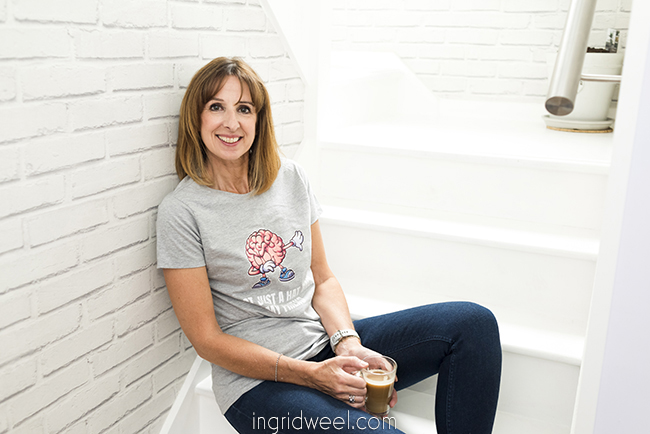
*Read the full article

Filed Under: Coaching, DS Consulting, Leadership & Development, Neuroscience, Reflections Tagged With: #besmart

26th February 2023

Is being a ‘grown up’ holding you back?

Re-connecting with your ‘inner child’ as a winning strategy in teams.

‘Babies and children are more open because, to survive, they have to learn as much as they can!’

Are you just too adult?

As well as coaching, I love a facilitating team and leadership development events. The word ‘team build’ often has the impact of Marmite! Generating a high degree of dread for what the team might be asked to do! How many people say they ‘hate’ role play? Lots of reasons given, mostly based on the discomfort of performing, or feeling stupid, maybe looking stupid. Very normal ‘adult’ responses. Ones that often increase the older you get. So I ask, is being a grown up, stopping you from growing?

Think back, to the freedom of a favourite childhood game.

Here’s one of mine.

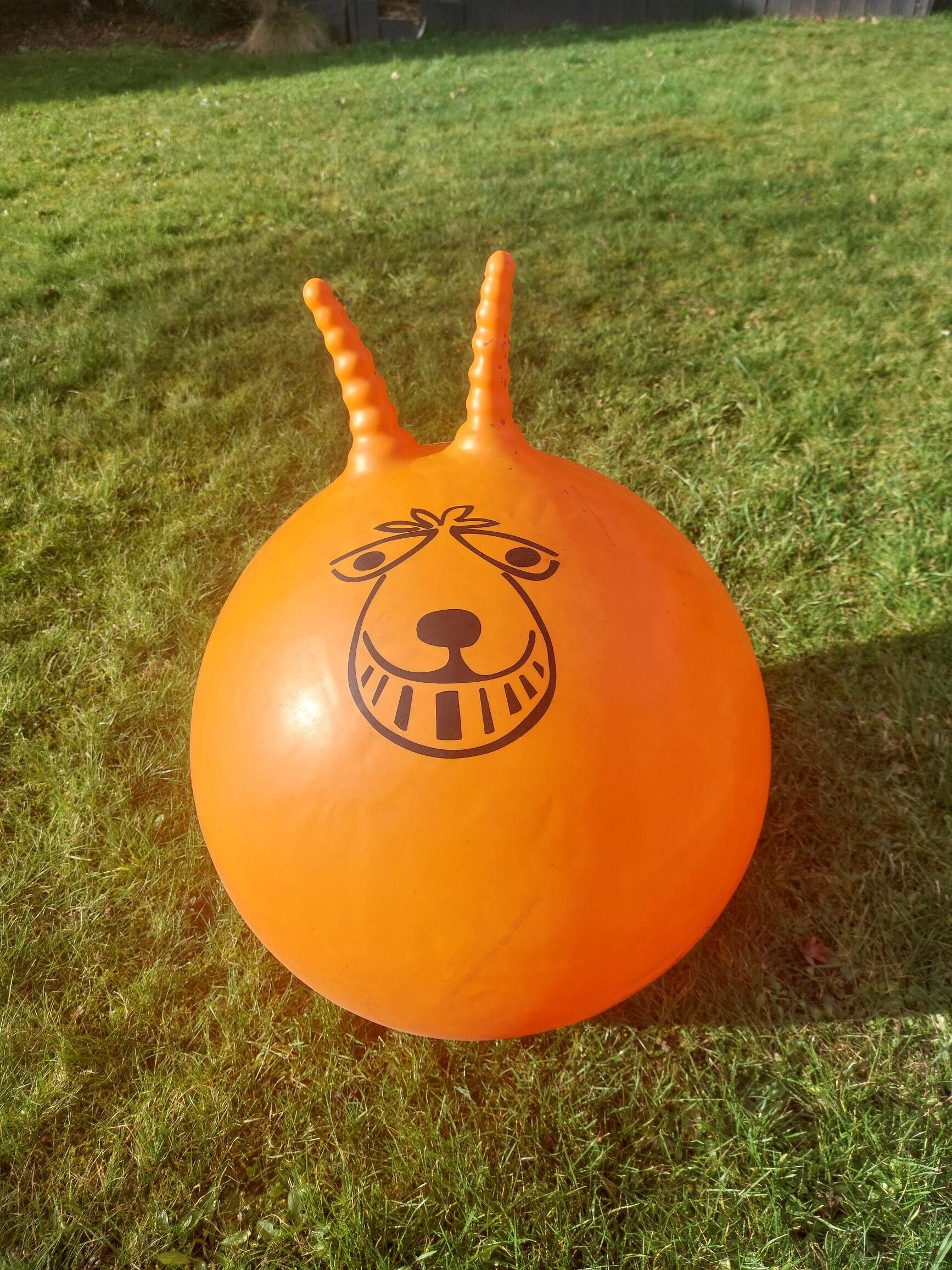
At about eight years old I wanted to be a show jumper, I never had a horse or riding lessons. That didn’t matter. I set up jumps of varying heights using chairs and poles. My brother would help me, and was supposed to time me, score me and commentate (frustratingly, he was only four yrs old). I would do the same for him. My Space Hopper was my horse! A lovely but sometimes stubborn creature that would occasionally refuse a jump! With some gentle encouragement though, my ‘horse’ and I would try again and usually succeed. I loved that game, the whole thing of taking what I had seen on TV and re-enacting it in my garden. I would have hours of fun working out how to create, build and fixing what didn’t work and then trying it out.

The honesty of children at play

Two aspects come to mind here. Firstly the beauty of a child absorbed in a game as they play alone. How they make the noises of cars, trains, light sabres etc., they move with purpose and have animated, blunt conversations with their imaginary characters in imaginary worlds. They have no idea of anything else around them. Mentally processing and rehearsing through play.

Secondly, when children play together. It’s not all roses is it? How often does it involve tears or tantrums? The sensitive stand out as much as the boisterous. They mimic each other, they copy adults, they laugh, they misunderstand, knees get cut, toys get broken, they sulk and yet very often want to do it all over again.

As studies by psychologist Alison Gopnik have shown, young children’s awareness levels are far vaster than an adults. They have a higher levels of neural transmitters activating in their brains in new situations than adults do. Babies and children are more open because to survive, they have to learn as much as they can!

The neurological and psychological impact of play and fun for teams.

The scenarios described above highlight what as adults we can crush; free, unencumbered engagement with ‘what if’ situations and problem solving. Toddlers and young children have the same needs to be accepted, heard, included and valued as adults. What they don’t have, before age of five is a high understanding of the judgement of others and social conformity.

The valuable outcomes of facilitated team activities

  • Stimulates creativity – Imagining and predicting sparks new neural connections. Endorphins, dopamine and serotonin can all be released in ‘playful’ situations.
  • Improves memory and remembering – Active over passive (eg listening to talks) tasks. ‘Doing’ is a more vivid experience, more readily stored and retrieved in our long-term memory.
  • Generates feelings – Providing opportunity to understand and develop emotional intelligence. e.g. Having an adult tantrum, is a misplaced childish trait in the workplace.
  • Enhances social connections and empathy – play, fun, and problem solving tasks can strengthen team bonds. Social connection is a key part in a person’s sense of well-being.

Need a quick ‘play time’ idea for your next team get together?

This can work in person and virtually.

Show the team pictures of 5 random items. E.g., A table lamp, a pen, a hairdryer, a computer mouse and a potato masher. Set a short time and have each team member come up with a brand new, unique use for each one. Take a vote on the favourite transformation.

Interested in a facilitated session with your team? Get in touch today.

Play allows you to see other perspectives, learn with and from others, see what makes others tick, know or test your limits. Play can be equally fun as it can be uncomfortable, yet because it is play it is the best place to work through the discomforts ready for reality.

Filed Under: DS Consulting Tagged With: #Coaching, #Leadership, #Neuroscience, #Wellbeing

14th November 2022

Neuroscience, can it really make a difference to your leadership impact?

Including some key neuroscience principles

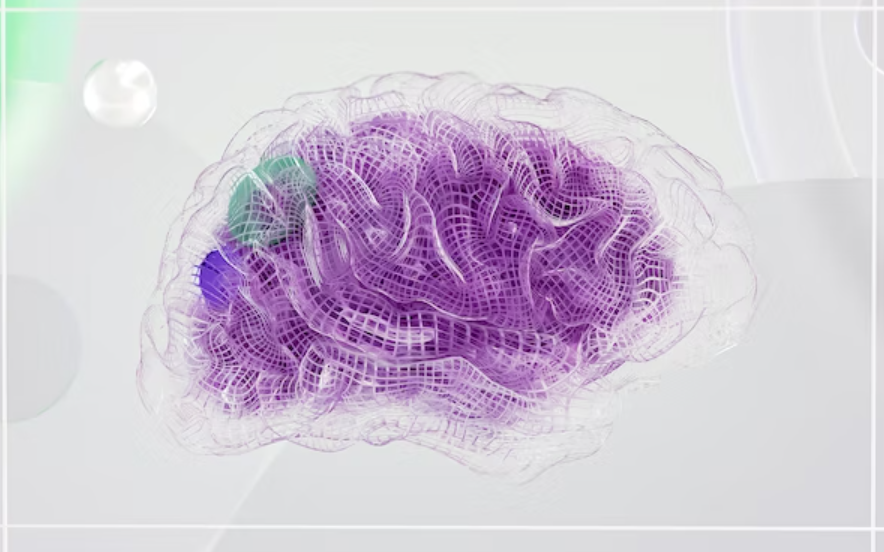
Picture from Unsplash – Neuroscience. Artist: Chris Schramm

Setting a scene

I am a leadership and neuroscience coach and about to have a chemistry session – a session to see if a potential client and I are a good match for a coaching relationship.  Not quite an audition, yet, an important time for both parties.  We both want the client’s needs and goals for coaching to be achieved. Rapport being gained in this meeting, is a good sign that we can communicate well together, build trust and progress with the changes being sort.

Meeting a client where they are

On this occasion as we explore what is happening for them and how they think coaching can help, a not uncommon theme arises. 

After many years of hard work, a ‘C’ suite position has been achieved.  How they describe their situation shows the immense pressure they are putting on themselves to be ‘immediately outstanding’. 

They see their role as one where they should be able to do it all, have an answer or solution to everything. The reality of all the ‘new’ and ‘unknowns’ has delivered a surprisingly high dose of vulnerability, self-doubt and uncertainty. 

Get in touch

How neuroscience can help

Neuroscience plays a significant part in how I coach. 

I have studied it (and continue to) over the last 5 years and apply neuroscience to my 20 years of leadership coaching. What does that actually mean?  What do my certifications in neuroscience allow me to draw on? 

  • It helps me reveal to my clients how their way of thinking and behaving has evolved. 
  • It gives insight into how your brain has perceived your experiences.
  • It enhances your self-awareness and consciousness to make change where, when and as it’s needed.
  • It puts neuroscience in to simple, usable format

A few principle of neuroscience

There are a few principles of neuroscience that are incorporated along with the usual skills for my coaching (listening, asking questions, being non-judgements, giving feedback etc) and my years of leadership experience.  Below are some of these ‘high-level principles’ (thank you, Dr Sarah McKay) showing some of what I am considering as I help you find deeper self-awareness and focus for change.

Some principles of neuroscience:

  1. Your brain is shaped by both genetics and the environments you have experienced and this influences your behaviour.
  2. Much of the brain is not hard wired. These ‘plastic’ network areas are growing and shrinking daily in response to your experiences.
  3. You rely on your memories to remember the past, understand the present and predict the future.  Like Chinese whispers recalling the past cannot be relied upon as accurate an reflection. 
  4. Emotions are an interrelated neural process to memory formation and retrieval. 
  5. Your relationships have been crucial to your ability to make positive change.  Belonging and being valued is part of your brain’s innate strategy for survival.
  6. Imagining, pretending, visualising for your brain is similar to actually doing.  Imagining activates the same brain regions as the actual behaviour and can speed up your learning experiences. 
  7. Your brain does many things without you being consciously aware of them. This includes how you respond unconsciously through thoughts feelings and actions.
Get in touch

Back to the chemistry session

The example above, gives an opportunity to explore the clients relationship with vulnerability, perfection and what is driving their behaviour. these neuroscience principles above help with understanding, perspective and opportunities for change.

Point five relates to relationships and I believe it to be the most significant to successful coaching partnerships.  There have been times when a client’s relationship history has been challenging, causing openness to be very testing.

In this chemistry session example, by being able to connect the concerns of this client to some specific aspects of neuroscience it helped them decide that working together was a going to benefit them.

Want to work with me?

I most often work with Execs, business owners, senior leaders and new managers. With the people aspect in mind, I also support psychologically impactful change initiatives (mergers, system changes, restructures).  I provide coaching, leadership and management development and other skills to aid workplace success, transitions and results.

Get in touch

Filed Under: DS Consulting Tagged With: #Coaching, #Leadership, #Neuroscience

30th August 2022

Leading, it was all going so well until…

How my coaching approach can help leaders when it gets tough.

It can all be going well and then…

Even (but not only) clients that are established leaders, at the top of their game, can get caught in a cloud of doubt.

For one client is was a series of small oversites. They managed them with no big impact on overall results, yet it knocked them trusting themselves.

For another it was a buy out that had an almost overnight impact on their being scrutinised for every action and decision.

A further client found that a change in the team upset their sense of place and a negative change in their behaviour and mindset ensued.

Another was worn out with coping following Covid restrictions and a constant sense of needing to adapt and change.

Get in touch

Managing intense feelings requires emotional awareness

Even with the clarity of objectives, goals, vision and process (and if you don’t have these, how can you have focus for what’s important workwise?), it’s how a situation makes you ‘feel’ that can take you off course from leading well and being well.

‘Leaders with empathy (EQ*) perform over 40% higher in employee engagement, decision-making, and coaching’.

Harvard Business Review via – https://www.soocial.com/emotional-intelligence-statistics/

Five ways coaching with me can build your leadership EQ* and mental strength?

When you know, you cannot unknow. My coaching approach builds on what you know, widening your options for managing your self and others:

  1. Psychometrics and 360 feedback to enhance self awareness
  2. Exploration for learning to manage feelings, so you can respond v re-act
  3. Reflection time to digest actions, options and desired outcomes
  4. Proven neuroscience insights that will aid resilience, optimism and confidence
  5. Leadership techniques to enhance team and individual performance

*Emotional Intelligence

You are not alone and I could be the coach that can help you to reconnect with all the benefits that leading can bring.

Get in touch

Filed Under: Coaching, DS Consulting, Leadership & Development, Neuroscience Tagged With: #Coaching, #Leadership, #Neuroscience, Resilience

8th July 2022

Does your work fulfil your purpose?

Three steps to finding your purpose and fulfilling it.

Head 4 Leadership

Do you ever have moments where the work you do, who you do it with and how you do it starts to niggle? 

Something doesn’t feel right anymore, and you may or may not know what is causing that.

Covid lockdown and remote working created space for considering how we live our lives and how we earn money to live that life.  Many renegotiated their hours, where they work, and a high number of people resigned. 

Resigning is a big step, and for some, that decision may have been made in haste.

Will resigning be the best step toward your true purpose?

One way to check this is to establish or re-establish connection with your purpose.  Your ‘Purpose’ is defined by your reason for being, it is what gets you out of bed in the morning, it gives you a drive, direction and motivation.

Your purpose changes through life and your may not have realised a change in yours.

You have an inbuilt neurobiology to find connection and shared purpose with others. It is what helps humans survive and thrive.

When there is disconnection through shared purpose it creates unsettling feelings, raises stress levels and can impact your confidence and self-belief. Your work-place is an important arena for connection with others and knowing your purpose can help you assess why you do what you do and if you are in the right environment.

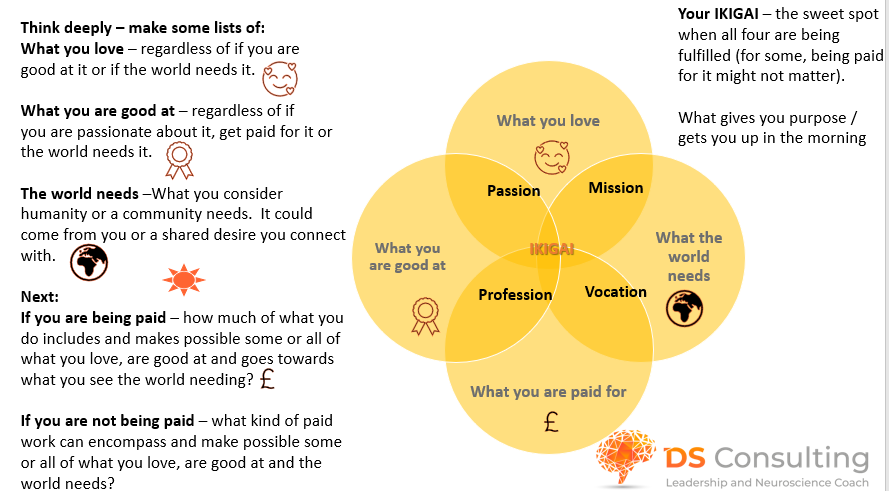
Find your purpose using IKIGAI

Ikigai is a Japanese word that combines the terms iki, meaning “alive” or “life,” and gai, meaning “benefit” or “worth.”  IKIGAI in terms of your career, is the sweet spot, where three key areas align with the work you do now or can steer some changes in your career.

Want help finding you IKIGAI?

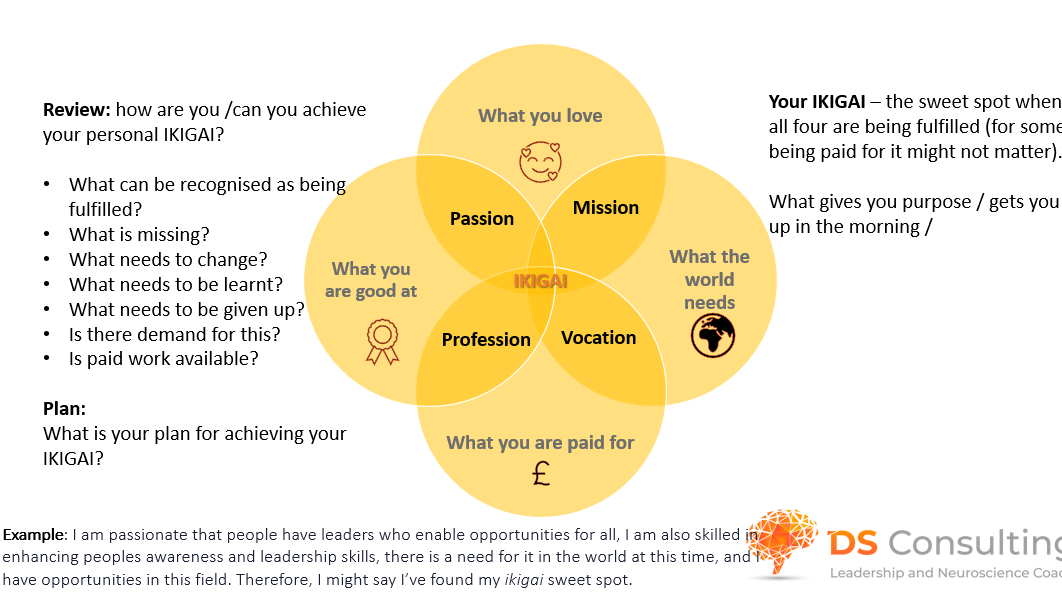
Three steps to identifying your IKIGAI / purpose

Step one – Self-reflection – without boundaries

Head 4 Leadership

Step two – Reflection analysis – What purpose has been revealed, how close are you to living it, how does your current work situation fulfil it or not?

Step three – Plan the changes that can give you that fulfilment.

Reach New Heights

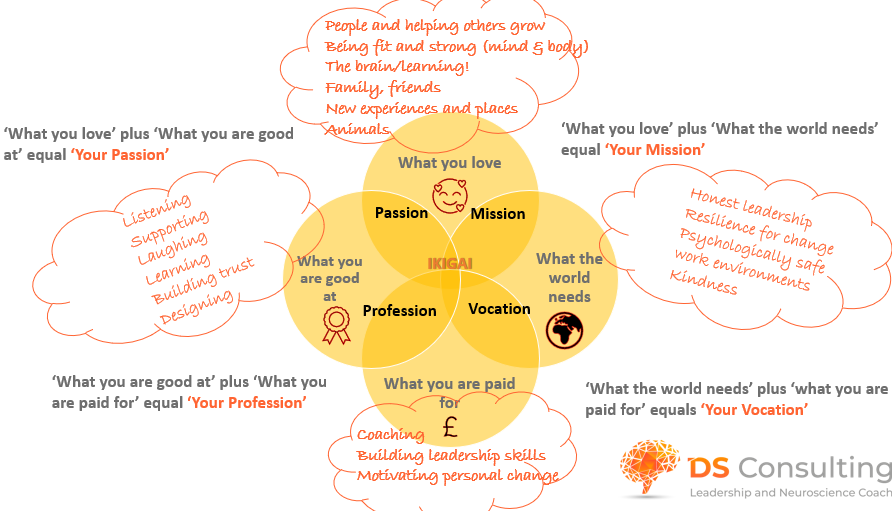
My IKIGAI

Head 4 Leadership

Your purpose, your IKIGAI, enables you to bring your authentic self to the workplace. 

Some may say values do that, and they are an aid.  The piece about what the world needs is what makes the difference. Being able to connect to it, express it, stand up for it and represent it.

Not everyone will agree with your purpose or like you for it, yet they will see the real you.

If you are unable to do what you love, unable to do what you are good at and see that what you do makes a positive contribution to the world, it could be time to start looking at your career choices?

Does the organisation you work in have a purpose you connect to?

If so, the opportunity of doing a little more of what you love and are good at is all you need. Some organisations give people time in the year to do something that matters to them or to learn something in which they are interested.  That might be all you need. 

What next?

  • Have a go at finding your IKIGAI
  • Share it with your leader/manager/team so they can understand you even more. compare with their purpose
  • See how any gaps can be filled in work or outside of it – sometimes it’s not paid work.  It could be raising money for something or volunteering.

Want help with this or to learn about how else I can support leaders to be their best for their teams and their team’s performance and engagement

Get in touch

Learn more about my Headstrong Coaching Programme – Reach New Heights in Leadership and Life

Headstrong Coaching Programme

Filed Under: DS Consulting Tagged With: #Coaching, #Leadership, #Neuroscience, #neuroscience #coaching #confidence, #purpose, Resilience

  • « Go to Previous Page
  • Page 1
  • Page 2
  • Page 3
  • Page 4
  • Interim pages omitted …
  • Page 6
  • Go to Next Page »

Primary Sidebar

Categories

  • Client Testimonials
  • CMPP
  • Coaching
  • DS Consulting
  • Head 4 Leadership
  • Leadership & Development
  • My news
  • Neuroscience
  • Reflections
  • Resiliance
  • Resilience
  • Special Offer
  • Workshop
  • Your career

Archives

  • April 2026
  • May 2025
  • March 2025
  • February 2025
  • November 2024
  • September 2024
  • August 2024
  • June 2024
  • May 2024
  • March 2024
  • January 2024
  • October 2023
  • August 2023
  • July 2023
  • June 2023
  • May 2023
  • March 2023
  • February 2023
  • November 2022
  • August 2022
  • July 2022
  • April 2022
  • February 2022
  • December 2021
  • November 2021
  • October 2021
  • August 2021
  • June 2021
  • May 2021
  • April 2021
  • March 2021
  • February 2021
  • December 2020
  • November 2020
  • October 2020
  • September 2020
  • May 2020
  • April 2020
  • March 2020
  • February 2020
  • January 2020
  • December 2019
  • October 2019
  • September 2019
  • August 2019
  • June 2019

Follow ​Dominique

  • E-mail
  • Facebook
  • Instagram
  • LinkedIn
  • Phone
  • Twitter
  • Home
  • About
  • Coaching Services
  • The Authentic Leader Book
  • Event speaker
  • News & blog
  • Contact

© Head4Leadership–2026

Manage Consent
To provide the best experiences, we use technologies like cookies to store and/or access device information. Consenting to these technologies will allow us to process data such as browsing behaviour or unique IDs on this site. Not consenting or withdrawing consent, may adversely affect certain features and functions.
Functional Always active
The technical storage or access is strictly necessary for the legitimate purpose of enabling the use of a specific service explicitly requested by the subscriber or user, or for the sole purpose of carrying out the transmission of a communication over an electronic communications network.
Preferences
The technical storage or access is necessary for the legitimate purpose of storing preferences that are not requested by the subscriber or user.
Statistics
The technical storage or access that is used exclusively for statistical purposes. The technical storage or access that is used exclusively for anonymous statistical purposes. Without a subpoena, voluntary compliance on the part of your Internet Service Provider, or additional records from a third party, information stored or retrieved for this purpose alone cannot usually be used to identify you.
Marketing
The technical storage or access is required to create user profiles to send advertising, or to track the user on a website or across several websites for similar marketing purposes.
  • Manage options
  • Manage services
  • Manage {vendor_count} vendors
  • Read more about these purposes
View preferences
  • {title}
  • {title}
  • {title}